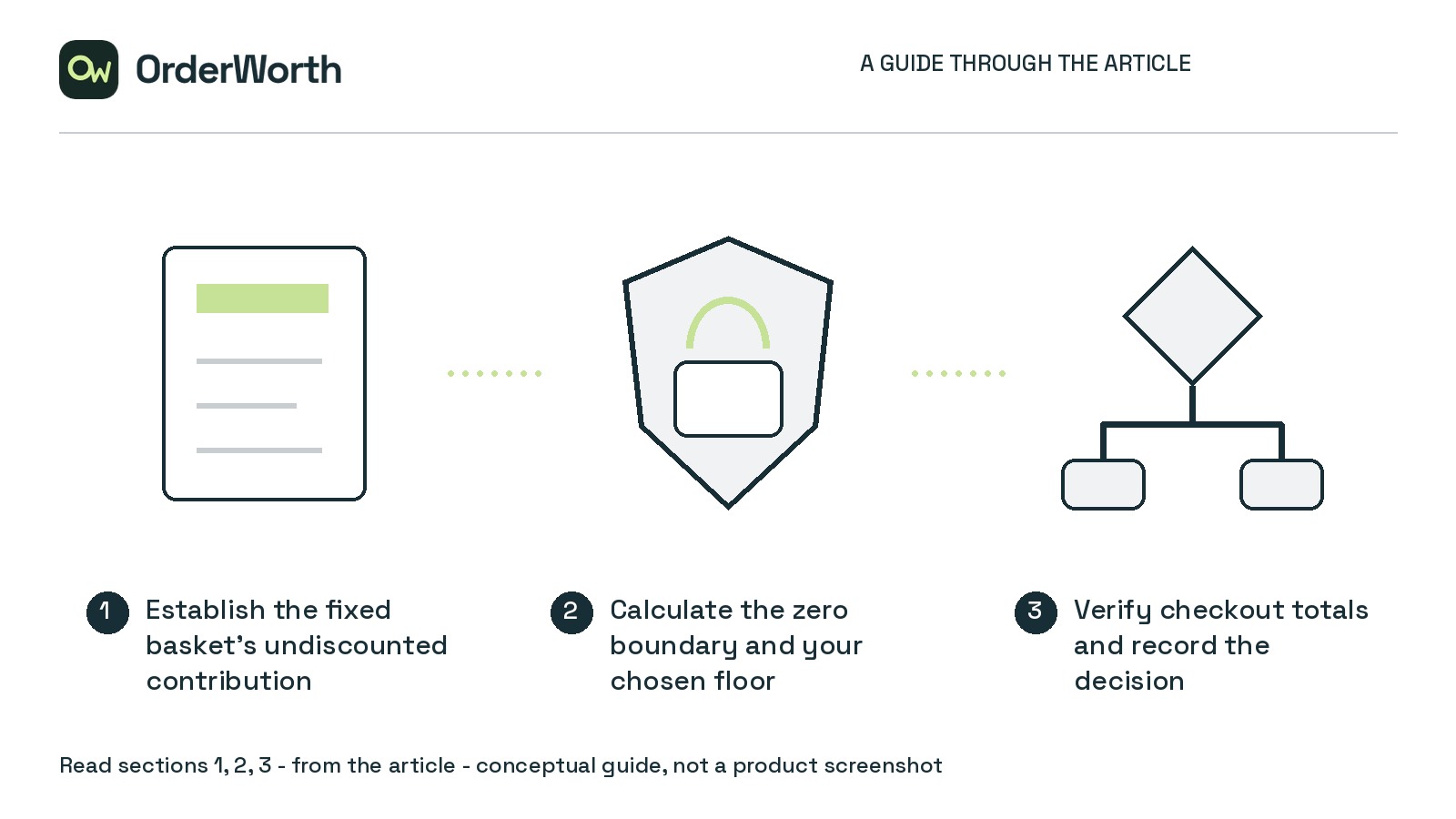
Before reusing last month’s OrderWorth estimate after a later refund, rerun the original historical range, inspect the affected order and keep the earlier result separate. Do not assume the fresh report reflects the refund, or that every difference was caused by it.
OrderWorth Free supports historical-range estimates, refund/order checks and manual contribution review. These capabilities remain usable alongside Pro; this review requires no Pro-only automation.
Keep your timeline, saved outputs and comparison note externally. This procedure does not assume native snapshots, frozen assumptions, refund-date filters or automatic prior-period restatement.
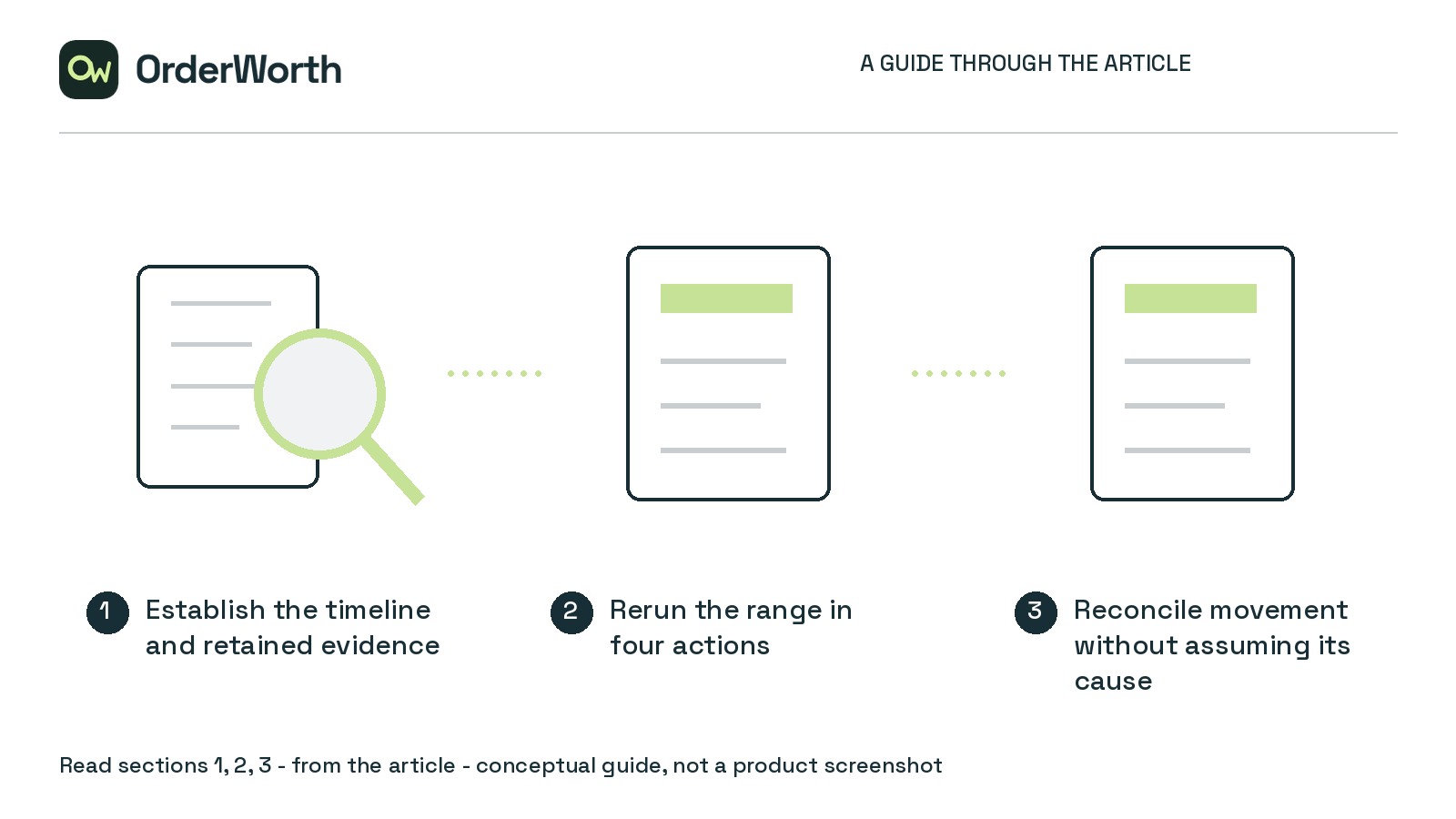
Establish the timeline and retained evidence
Start with existing product access, an identified cross-month refund, supporting order/refund and expense records, and confirmed currency.
In an external note, record the order and refund references and dates, original report range, preparation date, currency, order scope, cost coverage and expense assumptions. Record the date basis—the date used to determine inclusion in the range—and time zone where established. Mark unknowns rather than reconstructing them from today’s settings.
List the records actually checked and their dates. Define evidence cutoffs by source where possible: preparing a report on June 12 does not prove that every expense record through June 12 was available.
Decide what your retained evidence can establish:
- No retained baseline: report only a dated fresh observation, not a measured change.
- Retained report total: calculate the numerical difference between totals, but do not assume its cause.
- Retained order-level detail: compare the target order only to the extent that its earlier contribution, inclusion and inputs were preserved.
Assess a fresh estimate on its own evidence: a missing baseline does not automatically invalidate it.
In the hypothetical example below, order 4812 was placed on May 22, 2026. A May 1–31 report was retained on June 2. The order was refunded on June 10, and the manager reviews May again on June 12. These dates establish sequence, not where the plugin assigns the refund.
Rerun the range in four actions
1. Match the range and known basis. Use the original historical range and known report settings. Document anything you cannot match rather than substituting a presumed equivalent.
2. Preserve the fresh observation before editing inputs. Record the review date and save a copy of the fresh output externally before changing costs or expense assumptions.
3. Inspect the target order and checks. Use the refund/order checks and manual contribution review. Inspect missing-cost checks too: unknown costs are not confirmed zeros.
4. Record the available calculation evidence. Note the revenue, product costs and expense deductions you can establish, with source references and unresolved details. Use the reporting documentation to clarify supported review controls.
Keep three findings distinct: the refund exists in supporting records; it has an identifiable effect on the estimate; and the basis for its treatment in this historical range is established. Evidence for the first does not establish the others. If treatment remains unclear, record “unresolved” and the clarification needed.
A refund does not prove stock recovery, recovered product cost or fee reimbursement. Check return assessments, processor records and shipping charges separately, without counting return expenses twice.
Reconcile movement without assuming its cause
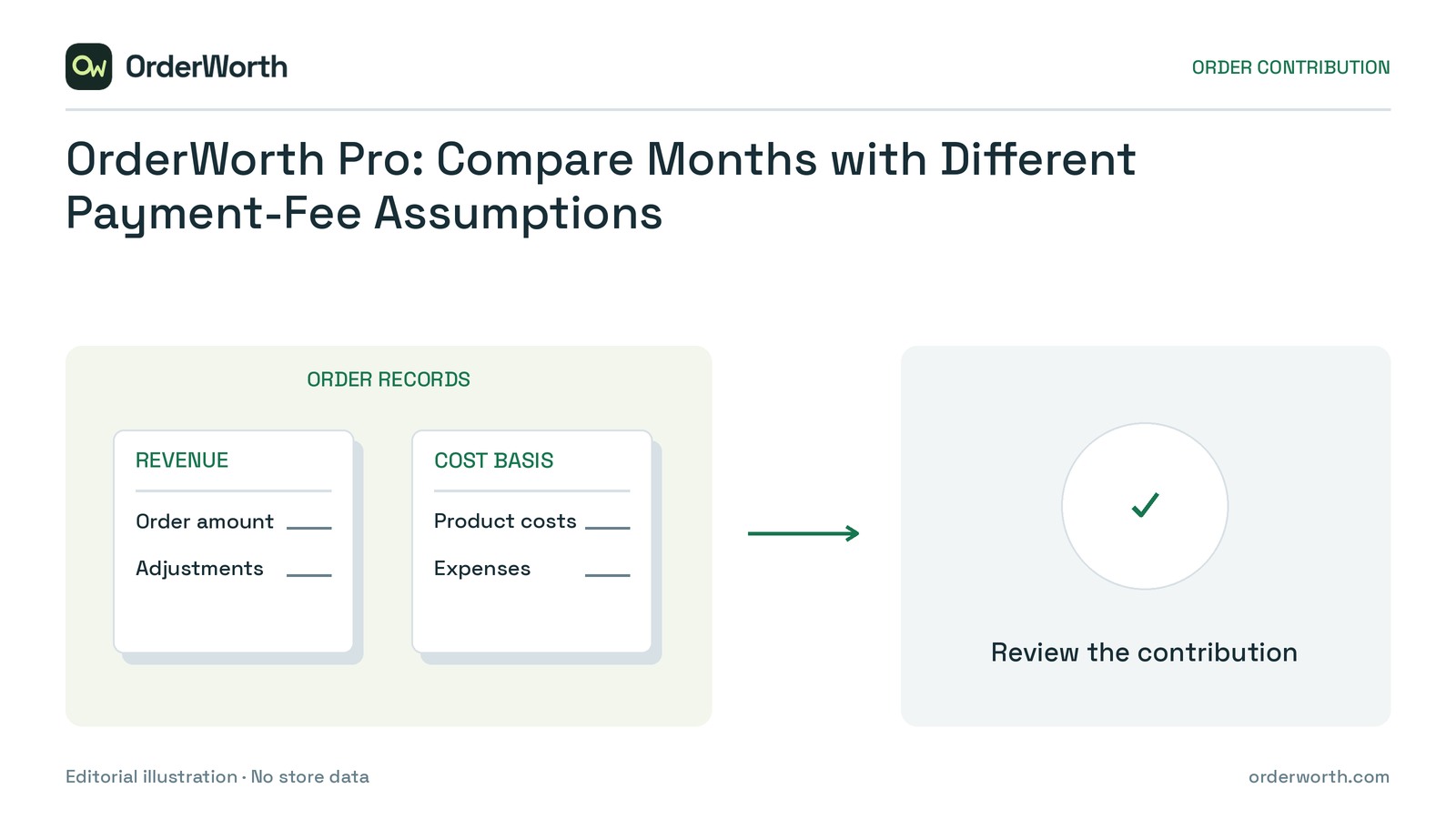
Compare revenue/refund treatment, recorded product costs, expenses and order coverage between reviews. Today’s catalog cost does not establish the original order cost, and entering a current cost must not be assumed to repair historical order data.
Work through the retained evidence
Suppose the retained evidence contains a May total of USD 2,400, confirms that order 4812 was included, and records its contribution as USD 120. The fresh review totals USD 2,325, includes the same target order and records its contribution as USD 70. These are hypothetical observations, not promised product outputs.
The total falls by USD 75, while the target order falls by USD 50. The remaining USD 25 is net report movement to investigate, not an identified expense or refund effect. The target order’s USD 50 movement also needs its own explanation.
Without the retained order-level evidence, only the USD 75 total difference would be demonstrated. Neither difference proves refund-only attribution.
An unchanged total would not resolve treatment either: offsetting input changes can conceal movement. Do not subtract the refund manually when its effect may already be reflected.
One checked order establishes neither whole-period validity nor a general refund-posting policy. Before publishing a whole-period recalculation, reconcile coverage and calculation assumptions across the included population.
Write the decision and assign the evidence requests
Choose the claim your evidence supports:
- Cite the earlier result as a dated record. Identify its original preparation date. Do not present it as incorporating the later refund or as newly validated.
- Publish a supported fresh estimate. State its review date, scope, evidence cutoffs, assumptions and exclusions. With a baseline, label it as a recalculation and retain both results. Without one, make no measured-change claim.
- Hold a specific claim. Name what remains unsupported—for example, refund-only attribution or a whole-period recalculation—and assign the missing evidence request.
If plugin detail is insufficient, WooCommerce order/refund records and an external expense worksheet can support a separately labelled manual estimate. That does not establish the plugin’s period treatment.
These remain order-contribution estimates, not accounting profit, tax statements or cash-flow reconciliations. Currency, cost completeness, expense assumptions and refund treatment constrain their use.
A hypothetical review note:
Reviewed June 12, 2026: May estimate retained June 2: USD 2,400. Fresh observation: USD 2,325. Evidence checked: the June 2 report and target-order summary, June 12 output and June 10 refund record only. Expense and return evidence remain unconfirmed. Hold refund-only attribution and publication of the whole-period recalculation; the earlier figure may still be cited solely as the June 2 record.
Finish that note with specific owners and requests:
- Report preparer: locate the earlier target-order calculation inputs and both reviews’ order-inclusion records. Own the full reconciliation of the target order’s USD 50 decrease using the finance and returns findings, and investigate the remaining USD 25 net movement. Mark unavailable evidence unknown.
- Finance reviewer: reconcile the refund and payment, shipping and other expense deductions against supporting records, recording which dates those records cover.
- Returns lead: establish any returned goods, recovered product cost and return expenses from records, or explicitly confirm that evidence remains unavailable.
Keep the earlier record intact, and publish a recalculation only when its scope and treatment are supported.