Start with the basket’s contribution—revenue minus product, payment, shipping and packaging costs—not its product markup. Subtract the contribution you want to retain, then adjust the remaining discount headroom for any reduction in percentage-based payment fees.
Customer-paid shipping is revenue; carrier charges are a separate expense. Keep both visible, and verify the proposed discount against checkout totals and documented fee terms.
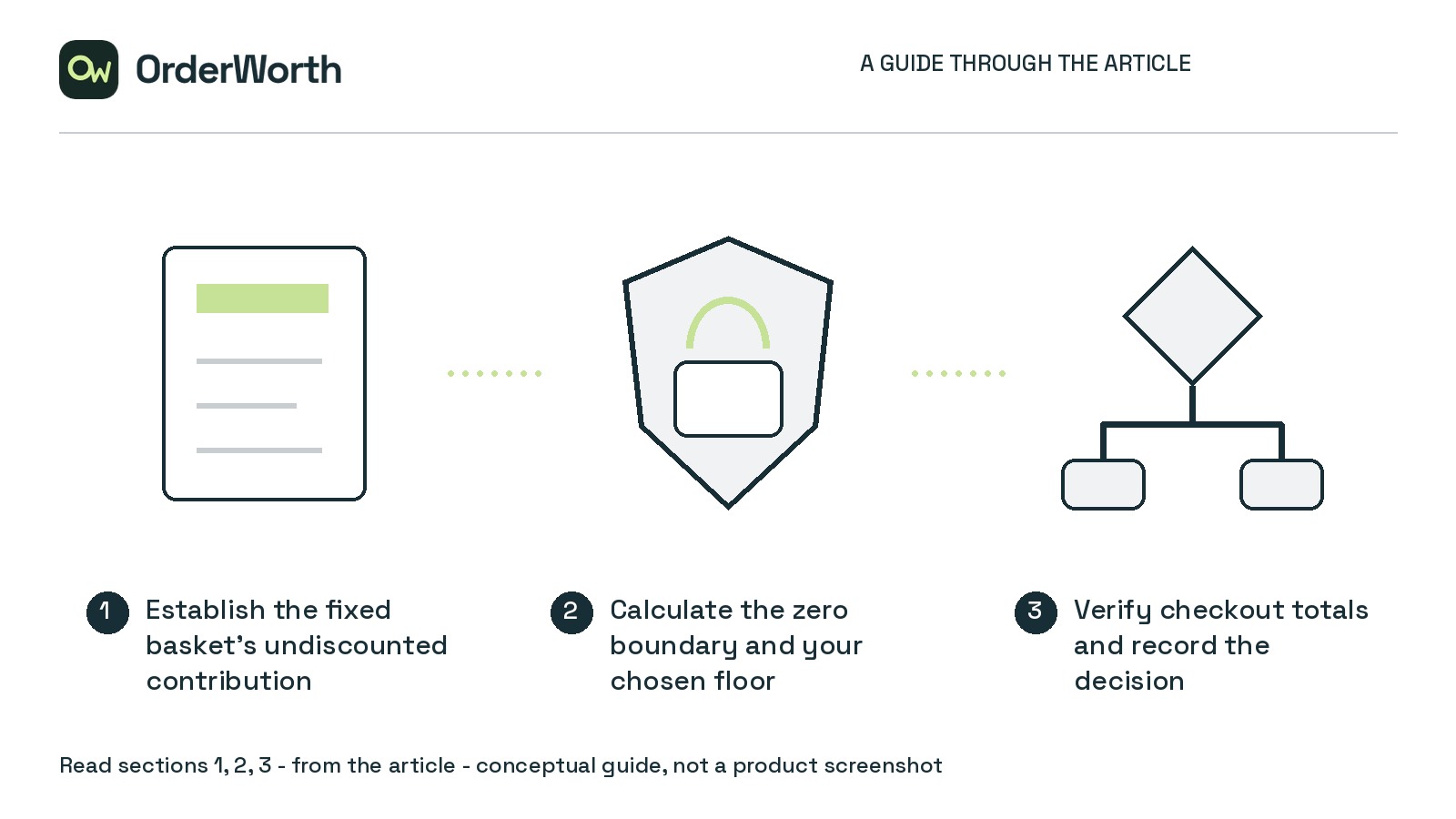
Establish the fixed basket’s undiscounted contribution
Create an independent worksheet recording the basket reference, products, quantities, currency and review date. For each input, retain its amount, evidence reference and status: confirmed, explicitly assumed or unresolved.
Hold approval when a material cost is unknown. A blank expense is not a confirmed zero.
This hypothetical example uses two identical physical units, one USD payment, no sales tax charged, no existing discounts and no customer order fees. Separate fulfilment expense is confirmed as zero within the example. Quantities and shipping arrangements stay unchanged throughout the initial calculation.
Assume supporting records establish these inputs:
- Merchandise revenue: $120. Two units selling for $60 each.
- Customer-paid shipping: $6. The charge shown at checkout.
- Product cost: $60. Two units costing $30 each, supported by records applicable to those units.
- Carrier expense estimate: $8. A current quote for the specified parcel and destination.
- Packaging expense: $2. The materials required for this shipment.
- Payment fee: 3% of the full customer payment, plus $0.30. Hypothetical provider terms, with the resulting fee rounded to the nearest cent.
These are illustrative inputs, not recommended rates or evidence about any provider. The carrier quote remains an estimate.
The customer payment is $120 + $6 = $126. The payment expense is 3% of $126 plus $0.30, or $4.08.
Undiscounted contribution: $126 − $60 − $8 − $2 − $4.08 = $51.92.
This is an order-contribution estimate, not accounting profit or cash flow. Advertising, salaries, rent, income tax and other unsupplied expenses remain outside it. Zero contribution is therefore not business break-even.
Calculate the zero boundary and your chosen floor
The discount reduces merchandise revenue only. Each $1 discounted reduces the payment-fee base by $1, saving $0.03 in percentage fees. The fixed $0.30 fee remains, so contribution falls by $0.97 per discount dollar before fee rounding.
To calculate a candidate discount:
1. Subtract the chosen contribution floor from starting contribution. This gives the headroom available for discounting.
2. Divide that headroom by one minus the percentage fee rate. Here, the divisor is 1 − 0.03, or 0.97.
3. Round the candidate downward to cents, then verify it. Fee rounding can change the final cent-level boundary.
Use these steps only when the discount reduces the fee base dollar for dollar, the percentage and fixed fee stay unchanged, and all other revenue and costs remain fixed. Cap the candidate at the eligible merchandise value.
If starting contribution is below the floor, no discount works under these fixed-basket assumptions. If it equals the floor, the unrounded model allows only a zero discount.
Find the cent-level zero-contribution boundary
With a zero floor, $51.92 ÷ 0.97 gives approximately $53.5258 before rounding. The rounded-down $53.52 candidate is conservative. Testing the next two cents shows where contribution reaches zero under the example’s fee rounding.
Product, carrier and packaging expenses total $70:
- $53.53 discount: Customer payment is $72.47. The fee is $2.4741, rounded to $2.47. Contribution is $72.47 − $70 − $2.47 = $0.00.
- $53.54 discount: Customer payment is $72.46. The fee is $2.4738, rounded to $2.47. Contribution is $72.46 − $70 − $2.47 = −$0.01.
Thus, $53.53 is the zero-contribution boundary in whole cents here, not an amount to approve automatically.
Preserve a chosen contribution floor
Suppose the manager instead chooses a $15 contribution floor. This is a hypothetical decision, not a universal recommendation.
Available headroom is $51.92 − $15 = $36.92. Dividing by 0.97 gives approximately $38.0619. Rounded downward, $38.06 is the candidate to verify against checkout totals.
Verify checkout totals and record the decision
Use your established safe checkout test without taking a live payment or dispatching goods. A checkout preview shows test-basket totals; it does not establish the final processor charge. Derive the payment expense separately from provider terms.
For the hypothetical $38.06 merchandise discount, the expected reconciliation is:
- Merchandise after discount: $120 − $38.06 = $81.94.
- Customer-paid shipping: unchanged at $6.
- Customer payment: $81.94 + $6 = $87.94.
- Payment expense: 3% of $87.94 plus $0.30 is $2.9382, rounded to $2.94.
- Contribution: $87.94 − $60 − $8 − $2 − $2.94 = $15.00.
A requested $40 discount instead leaves an $86 payment, a $2.88 fee and $13.12 contribution. It stays above zero but fails the chosen floor. On these assumptions, reduce the request to $38.06 rather than approve $40.
For a taxable basket, exclude sales tax from contribution revenue but use the provider’s documented fee base. If that base includes tax and the discount changes tax, the fee base may fall by more than the merchandise discount. Recalculate from tested totals rather than reusing 0.97.
Recalculate if the discount changes free-shipping eligibility, customer-paid shipping, carrier expense, quantities or packaging. A different payment method, minimum fee or fee tier also invalidates the fixed-basket calculation.
Keep the $8 carrier quote labelled as an estimate. The $38.06 discount leaves no reserve for higher shipping expense, so the $15 floor is not guaranteed. If you need a cushion, test a smaller discount against a higher, explicitly assumed carrier cost.
Now test the requested discount: approve if it meets the floor under the documented assumptions, reduce if a smaller discount does, decline if no acceptable offer can, or hold if material evidence is missing. Save the basket reference, tested discount, floor, estimated contribution, evidence, assumptions, reviewer and date.