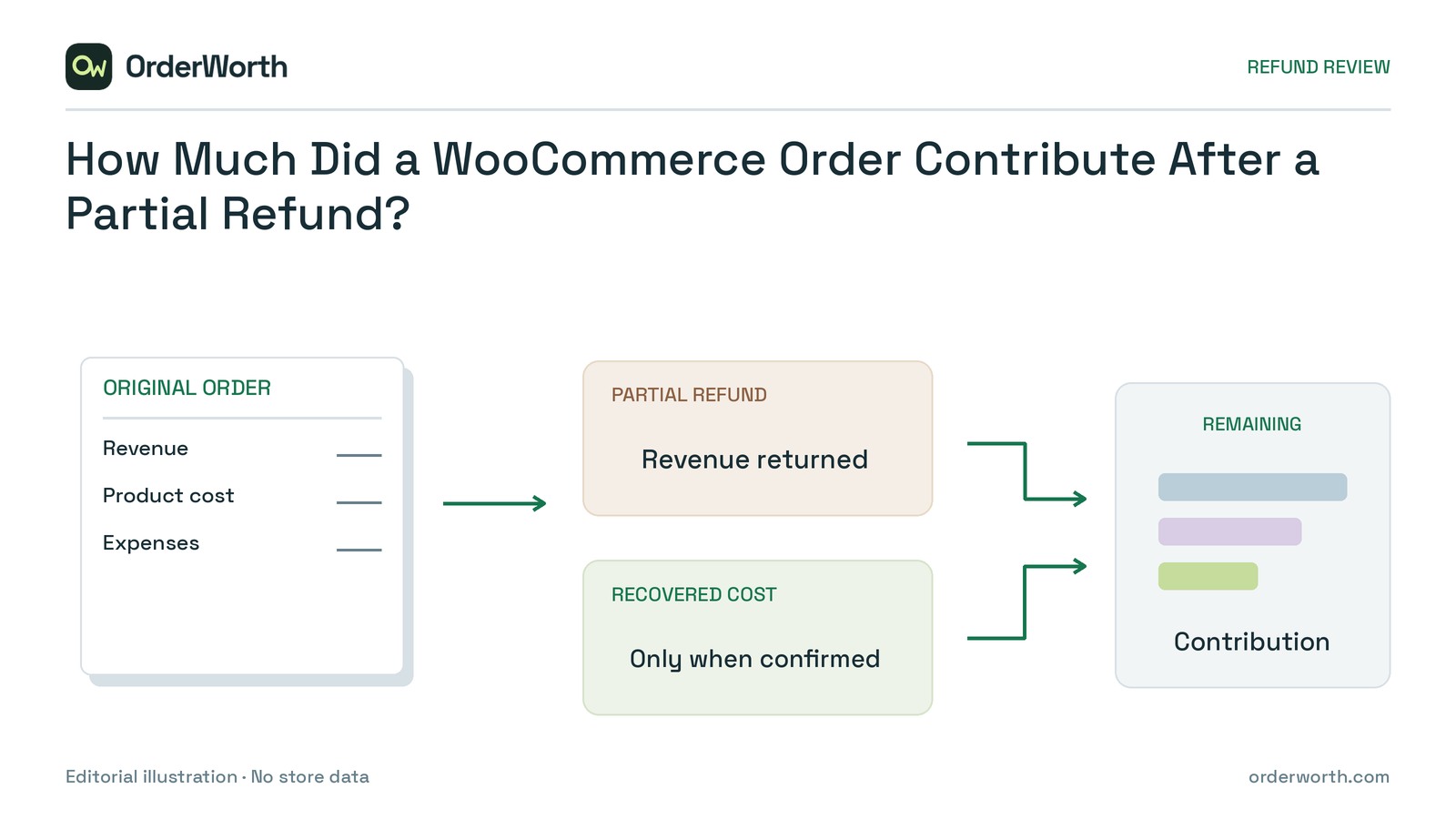
Start by confirming how much of the refunded unit's original product cost is recoverable. A refund record alone cannot establish that.
In the hypothetical two-unit order below, the same $110 refund leaves a $30 contribution with $40 of confirmed recovered product cost, or a $10 contribution loss with confirmed zero recovery. Unverified recovery leaves the result unresolved.
These are contribution estimates using the listed costs, excluding advertising and overhead—not accounting profit or cash flow.
Set up an evidence-linked worksheet
Create a spreadsheet with a row for each input and columns for amount, evidence reference and confirmation status. Distinguish confirmed, confirmed zero and unresolved. Record the order number, order date and refund date.
For this hypothetical example, assume two identical physical units, one currency, no customer-paid shipping or order fees, and no other supplied costs. Treat every listed amount as verified except recovered product cost, which starts unresolved.
- Original charge: $220. Order total, including sales tax.
- Original sales tax: $20. Order tax record.
- Refund: $110. Refund record for one of the two units.
- Refunded sales tax: $10. Tax recorded on that refund.
- Original product cost: $80. Recorded order cost: $40 per unit for two units.
- Recovered product cost: unresolved. Await return evidence and recovery confirmation.
- Retained payment expense: $7. Payment provider's final fee records.
- Outbound shipping expense: $12. Carrier charge.
- Packaging expense: $3. Packaging cost record for this shipment.
- Return shipping expense: $8. Actual return-label charge.
Calculate revenue after the refund and sales tax
Use the tax amounts recorded on the order and refund, not an estimated new tax split.
Original revenue is $220 − $20 = $200. The refund excluding its refunded tax is $110 − $10 = $100.
Remaining net revenue: $220 − $20 − ($110 − $10) = $100.
Subtracting the full $110 from the tax-exclusive $200 mixes two different bases.
Customer-paid shipping and order fees, if present, remain in revenue after relevant refunds and recorded tax. Carrier expenses are separate deductions. Do not deduct discounts already reflected in the order total again.
Verify recovered cost and retained expenses
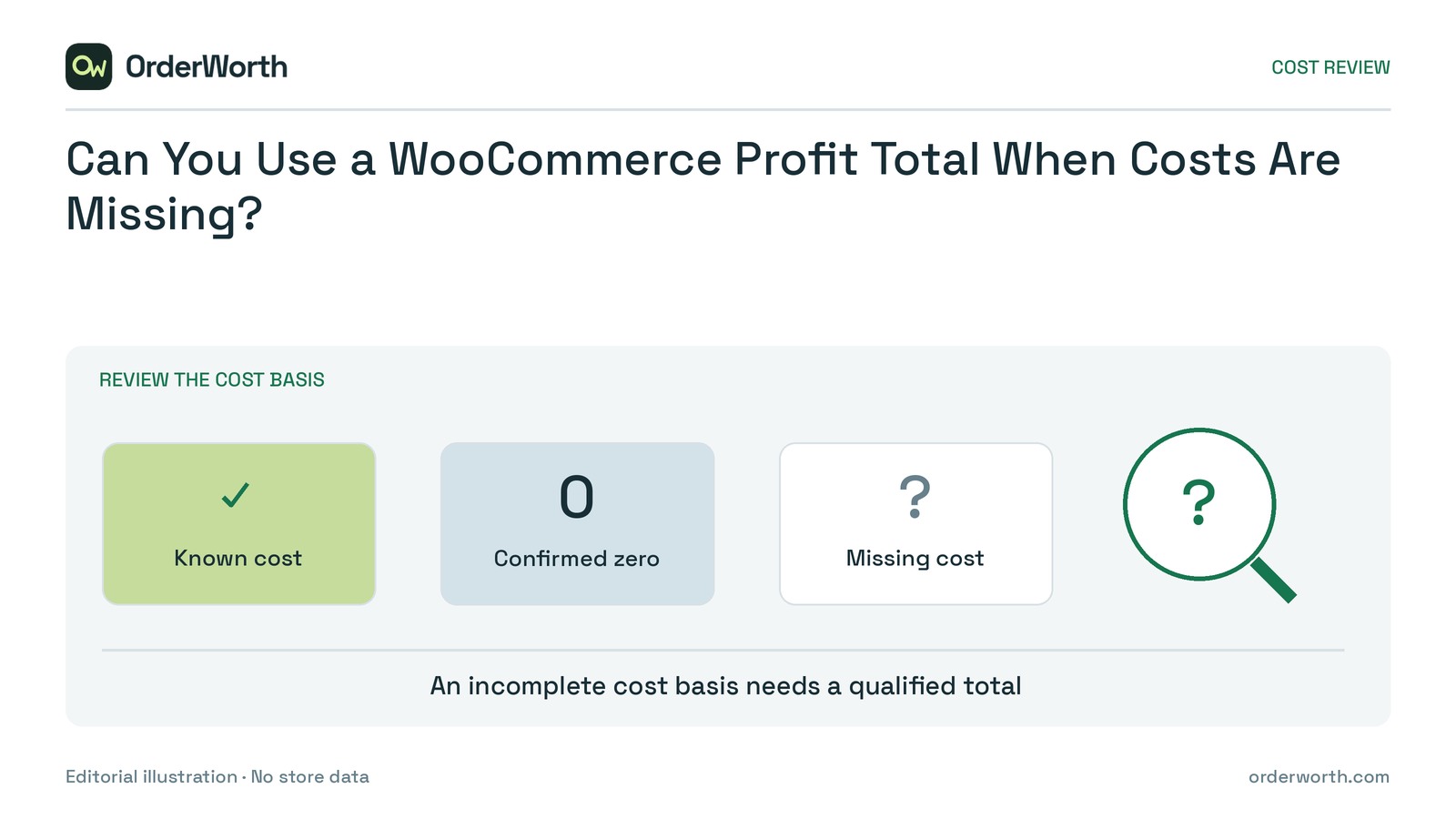
Do not finalize the estimate while a required input is unverified. Zero needs confirmation; it is not a placeholder for missing evidence.
Check 1: Returned quantity, condition and original cost
Keep the original $80 product cost on its own row and enter recovery separately. Match the return to the refunded order line, verify its quantity and condition, and use the original $40 unit cost—not today's replacement cost.
Arrival and a stock-count change do not, by themselves, establish full cost recovery. Ask the responsible reviewer to confirm the recoverable amount under your existing inventory policy.
A hypothetical completed row could read: recovered product cost: $40; evidence: return review RR-01; status: confirmed. Here, RR-01 contains the receipt, inspection, original unit-cost record and reviewer confirmation that the full cost is recoverable.
The $0 and $40 outcomes are illustrative endpoints. A different fully verified recovery amount is possible under the store's existing policy.
Check 2: Final payment fees
Check the payment provider's final records for fee credits or additional refund charges before confirming the $7 expense. Refunding half the order does not establish that half its fee was returned.
Check 3: Shipping and packaging charges
Verify actual charges and credits for outbound shipping, packaging and the return label. Do not assume that a quote or generated label represents the final charge. Count the $8 return charge once: separately or within a shipping total, never both.
Calculate only the outcome your evidence supports
Verified expenses total $7 + $12 + $3 + $8 = $30. Contribution here is remaining net revenue minus original product cost, plus confirmed recovered cost, minus those expenses.
With full recovery: $100 − $80 + $40 − $30 = $30 contribution.
With confirmed zero recovery: $100 − $80 + $0 − $30 = −$10, a contribution loss.
Recovered cost represents confirmed inventory recovery, not an extra cash receipt or an assumed resale price.
TRY THE SCENARIOS
Which recovered-cost entry does the evidence support?
Hypothetical two-unit order: $100 revenue after tax and refund, $80 original product cost ($40 per unit) and $30 expenses. All inputs except recovered cost are verified; only recovery evidence varies.
Receipt, inspection and full-cost confirmation are available
Record a confirmed $40 recovery, citing the receipt, inspection, original unit-cost record and reviewer confirmation. This supports the $30 contribution estimate.
An assessment confirms no recoverable cost
Record $0 as confirmed zero and cite the assessment. This supports a $10 contribution loss.
The recoverable amount is still unverified
Leave recovered cost and contribution unresolved. Request the missing receipt, inspection or reviewer confirmation needed to establish an amount; do not substitute zero.
Compare all scenarios
| Situation | What happens |
|---|---|
| Receipt, inspection and full-cost confirmation are available | Record a confirmed $40 recovery, citing the receipt, inspection, original unit-cost record and reviewer confirmation. This supports the $30 contribution estimate. |
| An assessment confirms no recoverable cost | Record $0 as confirmed zero and cite the assessment. This supports a $10 contribution loss. |
| The recoverable amount is still unverified | Leave recovered cost and contribution unresolved. Request the missing receipt, inspection or reviewer confirmation needed to establish an amount; do not substitute zero. |
Illustrative examples. Your selection is not saved or sent, and changes no store settings.
Finish with evidence or a named unresolved task
If an input remains unknown, record what is missing, which evidence will resolve it and who will supply it. A task might read: recovered cost unresolved; warehouse inspection needed; warehouse lead to supply the inspection record. Keep verified inputs and calculate the final result only once the required evidence is confirmed.
Date the worksheet and retain it with the original order. Revisit it after later refunds or expense corrections. If you summarize orders by their original order dates, update the affected period when the order's figures change.
This is an order-contribution estimate, not accounting profit, cash flow, a tax calculation, tax advice or an inventory-valuation policy. Advertising, salaries, rent, income tax, other overhead and unsupplied costs are excluded.
Next, reconcile one real partially refunded order. Finish with either a supported contribution figure or, for every unresolved input, the missing record and the person responsible for providing it.