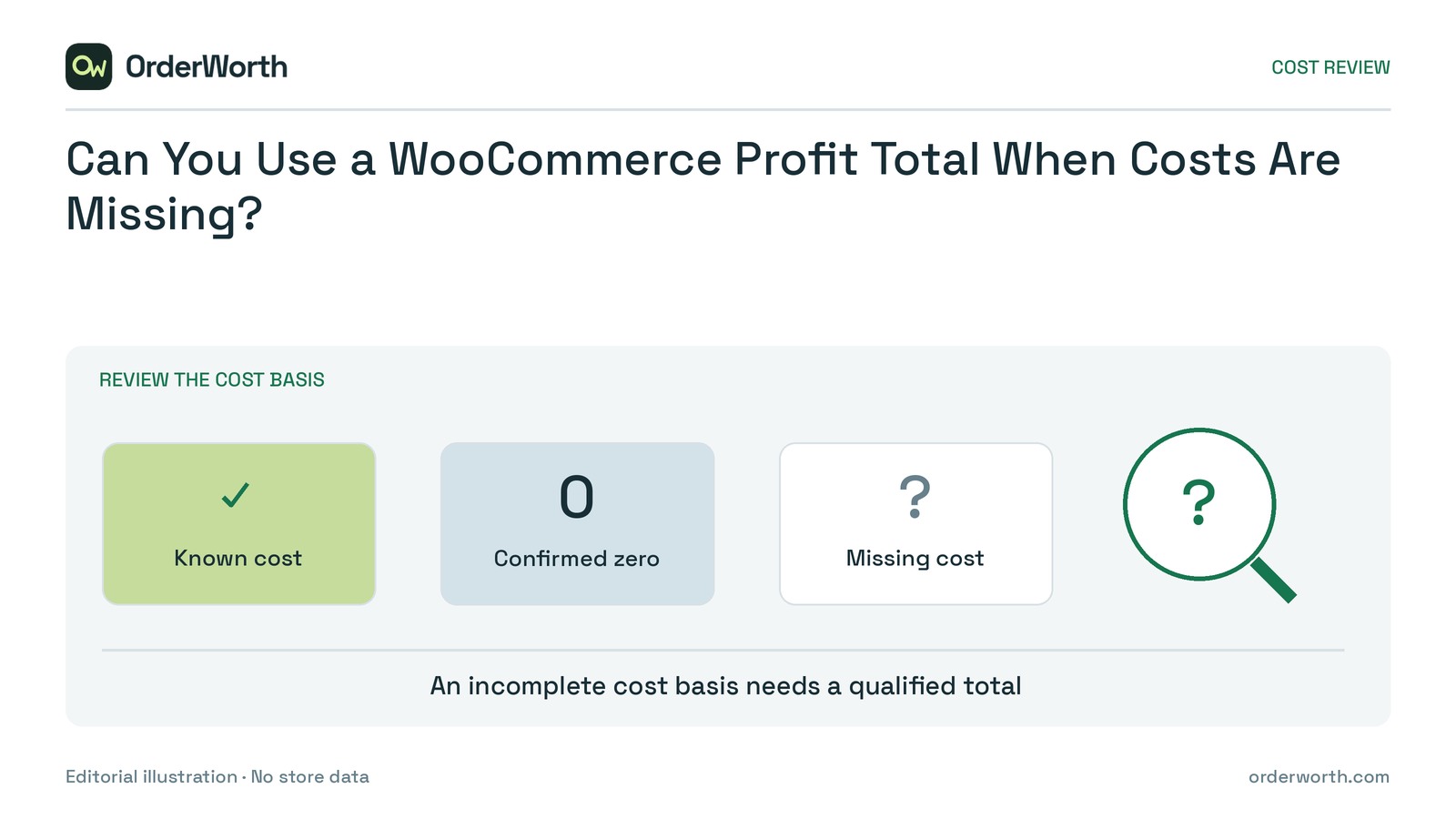
You can use the total only as a clearly qualified subtotal for identifiable orders with verified inputs. If unknown costs have been counted as zero, do not use the displayed total as it stands.
Missing costs leave whole-period contribution unknown. Unresolved orders may include losses, so a supported subtotal is not a guaranteed minimum.
Start by matching the period’s order IDs against the IDs contributing to the total. Appearing in a report does not prove an order’s cost inputs are valid.
Match the population and reconcile order IDs
Create an independent reference list of the orders your monthly update intends to describe, using an available export or manual list. No new plugin is required.
Match the reference list and report on:
- Dates: the same date basis, start, end and time zone.
- Scope: the same order statuses and currency, or a verified common reporting-currency basis.
- Timing: record when each list was prepared.
Match IDs in both directions. Investigate reference orders absent from the report and report orders absent from the reference list. Resolve duplicates; multiple item rows must not count as separate orders.
Do not remove orders from the reference list merely because the report excludes them. Those exclusions need explaining.
Build a one-row-per-order evidence ledger
For each order ID, record whether it contributes to the total, its classification, net revenue or unresolved, contribution amount or report-row reference, evidence references, responsible person and next action.
Classify by evidence: supported inputs, unresolved product cost, or other exclusion or unresolved input. Use one primary classification per order; retain additional issues in notes so counts do not overlap.
These two hypothetical ledger entries belong to the 100-order example below:
Order 1042: unresolved product cost
Net revenue is $120. Contribution is unresolved, and the order is excluded from the total. Evidence request P-1042 is awaiting a dated purchasing record tied to the original units.
The purchasing lead must supply cost and quantity evidence. The store manager must then check the remaining inputs before including the order.
Order 1078: supported inputs, including a genuine zero
Net revenue is $50. Contribution is $42, assuming verified zero original product cost, $8 in total supplied order expenses and no other deductions. The order is included in the total.
A dated inventory receipt and cost-review note Z-1078 document genuine zero cost for every unit. The store manager has verified the remaining inputs and tied the $42 contribution to report row 1078.
For unresolved costs, seek records applicable to the original order. Check whether amounts are per unit or already extended line totals before applying quantities. An order-level total must cover all original units.
Confirm genuine zeros from evidence, not convenience. Today’s catalog cost is not historical evidence unless you establish that it applied to the original order. If evidence remains unavailable, keep the cost unresolved.
Decide whether the displayed total is usable
Apply this sequence before publishing a number:
- Unfinished scan: finish it before establishing final coverage or treating its figures as complete totals.
- Completed report excluding unresolved orders: use a qualified subtotal only when the contributing orders have supported inputs and are identifiable.
- Completed report counting unknown costs as zero: correct evidence-backed inputs and regenerate, or sum only individually verified order-contribution amounts. If you cannot identify those amounts, defer the numerical claim.
Optional software support: OrderWorth Free and Pro withhold estimates for missing or inconsistent inputs and exclude those orders from aggregate contribution and margin. Unfinished scans show no complete totals. Missing-data review can locate gaps, and an order-level product-cost override can record a verified original total, including genuine zero, without changing native costs. You must still obtain historical evidence; importing current product costs does not repair historical order costs. The order-review documentation explains these entries.
Measure coverage without estimating the missing contribution
Use net revenue consistently for included and reference orders: revenue after sales tax and refunds, retaining customer-paid shipping and order fees. Omit revenue coverage when the reference population’s total net revenue is unknown or zero.
Consider a hypothetical completed report for 100 June 2026 orders in USD, with no refunds and verified net revenue for every order:
- 80 orders have supported estimates; 15 lack confirmed product costs and five have unresolved expense inputs.
- The included orders have $7,000 net revenue and $1,400 estimated contribution.
- All 100 orders together have $10,000 net revenue.
Order-count coverage is 80 divided by 100: 80%. Revenue coverage is $7,000 divided by $10,000: 70%. These describe coverage, not confidence in whole-period contribution.
The included-order margin is $1,400 divided by $7,000: 20%. Do not apply that margin to the unresolved orders’ $3,000 revenue or scale the subtotal into a whole-period estimate. Neither coverage measure establishes the missing orders’ costs or contribution.
Label the update and finish the review
A qualified subtotal answers a question about the identified, reviewed orders. It does not answer “What did all orders contribute?” Defer that whole-period claim until the gaps are resolved.
For the hypothetical example, a useful qualification is:
Possible update: Prepared July 2, 2026. The population comprises USD orders created June 1–30, 2026, using UTC boundaries, with processing or completed status at review. Estimated contribution is $1,400 across 80 of 100 orders, covering $7,000 of $10,000 net revenue. Fifteen orders lack confirmed product costs; five have unresolved expense inputs. Whole-period contribution remains unknown.
Contribution deducts recorded product costs and supplied order expenses from revenue after sales tax and refunds. It is not accounting profit, cash flow or a tax calculation. Advertising, salaries, rent, income tax, other overhead and unsupplied costs remain outside it.
After evidence-backed corrections, regenerate the report and reconcile IDs again. Retain the ledger and preparation date; later refunds or corrections can change a creation-date period.
Before sending the update: